Turf installation looks straightforward until a delivery arrives late, the soil drains poorly or the chosen grass struggles in shade.
For landscapers, those issues affect labour, timing and the final result. Reliable turf installation on the Central Coast depends on accurate planning, suitable turf and practical local knowledge.
That is where Peats Ridge Turf Supplies fits into the process.
How Does Turf Installation Work on the Central Coast?
Turf installation involves more than rolling grass across prepared soil.
Before installation begins, landscapers assess sunlight, drainage, soil condition, slope and expected foot traffic. They then calculate the correct quantity, choose a suitable variety and coordinate delivery so the turf can be laid while fresh.
The process usually includes:
- Site assessment: The landscaper checks shade, drainage, access and soil quality before recommending a turf variety.
- Ground preparation: Existing grass, weeds, rocks and debris are removed before the soil is levelled and improved.
- Accurate measuring: The installation area is calculated carefully to reduce shortages and unnecessary waste.
- Turf delivery and laying: Fresh turf is installed promptly, with staggered joins and close contact between the roots and soil.
- Watering and establishment: The new lawn is watered consistently while the roots establish below the surface.
Each step affects the next, which is why experienced landscapers tend to work with suppliers who understand the full installation process.
Why Local Turf Knowledge Makes a Practical Difference
The Central Coast includes a wide range of growing conditions.
Some properties have sandy soil and strong coastal exposure. Others have heavier ground, limited sunlight or poor drainage. A turf variety that performs well in one suburb may require far more maintenance in another.
Landscapers can compare locally suitable options through the range of grass varieties available from Peats Ridge, then match each option to the conditions of the site.
That local judgement matters because turf is a living product. It responds to heat, moisture, shade and soil structure rather than simply following the project plan.
The Bureau of Meteorology climate information can also help landscapers understand rainfall patterns, seasonal temperatures and unusually dry conditions before scheduling work.
A week of hot weather may require a different watering plan from a mild, overcast installation period. Likewise, heavy rain can delay soil preparation and make compacted ground harder to correct.
Local knowledge turns those variables into manageable decisions.
Which Turf Varieties Suit Different Landscaping Projects?
There is no universal turf variety for every Central Coast property.
The best choice depends on how the lawn will be used, how much sunlight it receives and how much maintenance the client is prepared to manage.
| Project condition | Turf priority | Why it matters |
| Partly shaded garden | Shade tolerance | Turf must remain healthy with fewer hours of direct sunlight |
| Busy family lawn | Wear recovery | The surface needs to recover after regular foot traffic |
| Sunny open area | Heat tolerance | Strong sunlight can stress unsuitable varieties |
| Rental or low-maintenance property | Manageable upkeep | The lawn should remain presentable without constant attention |
| Sloping site | Soil stability | Fast establishment may help reduce exposed soil movement |
For gardens with mixed light, landscapers may consider Sir Walter Buffalo for Central Coast properties because it is commonly selected where shade tolerance and a softer leaf are important.
On sunnier sites that experience regular activity, Kikuyu grass on the Central Coast may be considered because of its vigorous growth and ability to recover from wear.
The choice should still reflect the actual site.
A tough turf variety cannot compensate for poor drainage, deep shade or unsuitable soil. Landscapers get better results when turf selection and preparation are treated as one decision rather than two separate tasks.
What Benefits Does Professional Turf Installation Provide?
Professional installation gives clients a finished lawn quickly, but speed is only one advantage.
A well-installed lawn can improve the appearance, usability and stability of an outdoor area. It may also reduce exposed soil, dust and mud while creating a practical surface for recreation.
The main benefits include:
- Immediate visual improvement: Turf creates a complete green surface much faster than establishing a lawn from seed.
- More consistent coverage: Professionally laid rolls reduce patchy growth and uneven spacing.
- Better soil contact: Correct levelling and rolling help roots make contact with the prepared surface.
- Reduced erosion risk: Established turf can help protect exposed topsoil, particularly on gently sloping sites.
- Clearer maintenance planning: Clients receive guidance on watering, mowing and early lawn care.
These benefits depend on correct installation.
Poorly prepared soil can cause uneven growth, water pooling and weak root development. Gaps between rolls may dry out, while turf laid over compacted ground can struggle to establish.
Professional landscapers reduce those risks by preparing the area carefully and adjusting their method to the site.
Why Accurate Measuring Protects the Project Budget
Measurement errors create problems quickly.
Too little turf can stop the installation before the lawn is complete. Ordering extra turf later may also produce small differences in colour or maturity between batches.
Too much turf increases cost and can leave unused rolls that cannot be stored indefinitely.
Landscapers can use Peats Ridge guidance on measuring a lawn for turf to calculate rectangular areas, irregular spaces and sections interrupted by paths or garden beds.
A sensible calculation usually includes a small allowance for trimming and unusual shapes.
Accurate quantities help with:
- Quoting: Labour and material costs can be estimated more reliably.
- Scheduling: Delivery size and installation time become easier to plan.
- Waste reduction: Fewer unused rolls need to be discarded.
- Batch consistency: The full area is more likely to be completed using turf from the same delivery.
Good measuring is not the glamorous part of landscaping, but neither is returning to a job because the final six square metres are missing.
How Soil Preparation Influences Turf Establishment
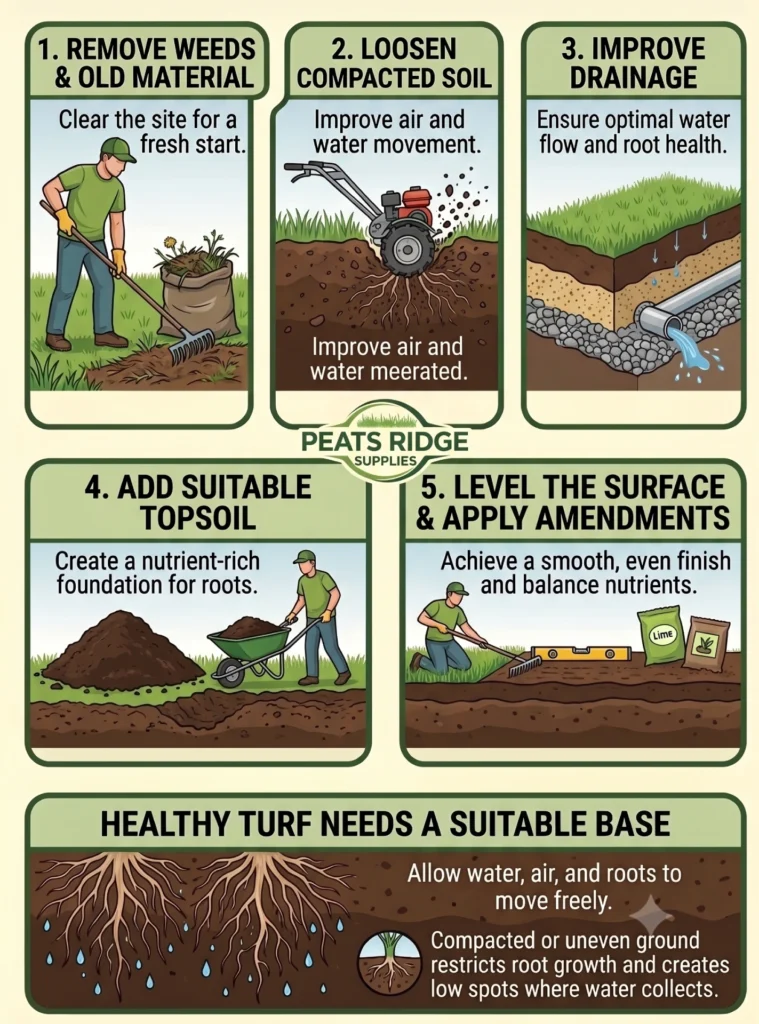
Healthy turf needs a suitable base.
The soil should allow water, air and roots to move through it. Compacted or uneven ground can restrict root growth and create low spots where water collects.
Before turf arrives, landscapers may need to:
- remove weeds and old lawn material
- loosen compacted soil
- improve drainage
- add suitable topsoil
- level the surface
- apply soil amendments where appropriate
The NSW Department of Primary Industries provides information on soils, plant health and land management that can support broader preparation decisions.
Soil improvement should be based on actual conditions rather than guesswork.
For example, adding more material to poorly draining soil may raise the surface without solving the underlying problem. Likewise, fertiliser cannot repair severe compaction.
A landscaper who identifies the cause first is more likely to create a stable growing environment.
Why Delivery Timing Matters More Than It Seems
Fresh turf begins losing moisture once it is harvested.
That makes delivery timing important, particularly during warm or windy weather. Turf left stacked for too long can heat up, dry out or become more difficult to establish.
Landscapers therefore need the site ready before the delivery arrives.
The soil should be prepared, access should be clear, and the installation team should be available to begin promptly. Watering equipment should also be ready rather than still sitting in a shop trolley somewhere across town.
Peats Ridge supports this planning by combining turf supply with local knowledge of Central Coast projects. Landscapers can review the broader Peats Ridge Turf Supplies range while planning variety, quantity and delivery requirements.
Reliable coordination reduces the risk of turf sitting unused while preparation work is still being completed.
How Should Newly Installed Turf Be Watered?
New turf needs consistent moisture while the roots establish.
The goal is to keep the turf and the upper soil layer moist without creating waterlogged conditions. The exact frequency depends on temperature, rainfall, soil type and exposure.
Useful watering principles include:
- Water promptly after laying: Early watering helps reduce moisture loss and improves contact with the soil.
- Check beneath the turf: The soil below the rolls should feel moist rather than dry or saturated.
- Adjust for weather: Hot, windy days may require more frequent watering than cool or cloudy conditions.
- Reduce watering gradually: Once roots begin establishing, watering can usually become deeper and less frequent.
- Watch for pooling: Standing water may indicate overwatering, low spots or drainage problems.
The Central Coast Council’s water conservation advice can help property owners and contractors make responsible watering decisions.
Clear instructions are important because the landscaper may complete the installation correctly, only for the lawn to struggle during the first week through inconsistent aftercare.
Why Landscapers Value a Dependable Local Supplier
Landscapers work to fixed schedules.
Turf delivery often needs to align with soil preparation, irrigation, labour availability and project handover dates. A delayed or incorrect order can affect several parts of the job.
A dependable supplier helps reduce that uncertainty.
Landscapers benefit from:
- Practical variety advice: Recommendations can be based on sunlight, wear and maintenance needs.
- Accurate order planning: Correct quantities reduce shortages and waste.
- Consistent turf quality: Uniform rolls are easier to install neatly.
- Local delivery knowledge: Timing can be coordinated around Central Coast conditions and site access.
- Clear communication: Questions can be resolved before they become site problems.
When a project requires confirmation about turf choice, measurements or delivery, landscapers can contact Peats Ridge Turf Supplies during the planning stage rather than waiting until installation day.
That early conversation often saves more time than it takes.
Better Turf Projects Begin Before the First Roll Is Laid
Successful turf installation on the Central Coast starts with informed planning.
Landscapers need to understand the site, choose an appropriate turf variety, measure accurately and prepare the soil properly. They also need fresh turf delivered when the area is ready.
Peats Ridge Turf Supplies supports that process with local knowledge, practical guidance and turf options suited to different Central Coast projects.
The result is not simply a greener lawn. It is a more predictable installation, a clearer maintenance plan and a finished landscape that has been designed to perform beyond the handover date.