
Timing a new lawn sounds simple until you realise turf is not a decorative afterthought. It is a living surface that needs the right conditions to settle, root and grow properly.
That is why so many homeowners and landscapers end up asking When Is the Best Time to Install Turf. The answer depends on weather, site preparation, grass type and how ready the space actually is. A good lawn starts with good timing, not guesswork.
What determines the best time to install turf?
The best time to install turf is shaped by a few practical factors rather than one magic month on the calendar.
Temperature matters because turf establishes through root growth, and roots respond to soil warmth. Moisture matters because fresh turf needs reliable watering while it settles in. Preparation matters because even premium turf will struggle if it is laid over uneven ground, poor soil or leftover weeds.
For people comparing turf options, it helps to think about timing as part of the whole project. The right installation window is really the point where the site is ready, the grass variety suits the conditions and the aftercare can be done properly.
When Is the Best Time to Install Turf in Australia?
In many Australian climates, spring and early summer are often strong times to lay warm-season turf. Soil temperatures are rising, days are longer and grass is moving into a more active growth phase.
That gives new turf a better chance to root in quickly and establish evenly. Faster establishment usually means less time in that awkward in-between stage where the lawn looks finished but still behaves like it needs constant supervision.
Autumn can also be a good option in many areas, especially when the weather remains mild and the turf still has time to settle before winter slows things down. Winter is not always impossible, but establishment is often slower, particularly for warm-season varieties that prefer warmer soil before doing their best work.
A simple seasonal view can help:
| Season | General turf installation outlook | Why it matters |
| Spring | Often ideal for warm-season turf | Rising soil temperatures encourage active growth |
| Early summer | Usually strong if watering is managed well | Fast establishment and vigorous rooting |
| Autumn | Often suitable in mild conditions | Turf can settle before colder weather arrives |
| Winter | Possible, but often slower | Cooler soil can reduce growth and delay rooting |
This is why timing should be based on conditions rather than habit. The best month is not always the one someone used once and now recommends with suspicious confidence.
Why does grass type affect installation timing?
The variety of turf plays a major role in deciding when installation will work best. Different grasses respond differently to temperature, sunlight and seasonal growth patterns.
For example, warm-season grasses are generally happiest when laid during periods of active growth. That means timing matters just as much as selection. When people compare different grass types, they are not just choosing how the lawn will look. They are also choosing how that lawn will establish and perform across the year.
Kikuyu is a good example. It is popular for sunny, high-use areas because it grows vigorously, recovers well and suits active outdoor spaces. If you are looking at whether Kikuyu is a good fit, it generally makes sense to install it when warm conditions support strong root development and active growth.
Sir Walter Buffalo is another widely chosen option, particularly for family lawns and landscapes where a hardy but softer-looking finish is preferred. For anyone considering whether Sir Walter suits the space better, the same principle applies. Better growing conditions at installation usually lead to better establishment.
In other words, asking when to install turf without asking which turf you are installing is a bit like asking when to bake something without mentioning whether it is bread or pavlova. The answer changes.
How important is site preparation before laying turf?
It is hard to overstate how much site preparation affects the final result.
Even perfectly timed installation can go wrong if the ground beneath the turf is uneven, compacted, full of weeds or poorly drained. Fresh turf needs direct contact with prepared soil so roots can knit into place quickly and evenly. If the base is rushed, the lawn often shows it later through patchiness, poor growth or drainage issues.
Before turf is delivered, the site should usually be:
- Cleared of weeds and debris
Old roots, rubble and weeds can interfere with proper contact between turf and soil. - Levelled carefully
A smooth surface improves appearance and helps prevent water collecting in low spots. - Checked for drainage
Turf copes far better when water moves through the site properly rather than sitting around the roots. - Prepared with realistic measurements
Accurate quantities save time, reduce waste and make installation far smoother.
That last point matters more than people think. Before ordering, it helps to work out the area first so the turf quantity matches the design. Estimating by eye can feel heroic in the moment, but it rarely ends in mathematical excellence.
Can turf be installed outside the ideal season?
Yes, but the conditions need to be managed more carefully.
Turf can often be laid outside the classic spring window, especially when the site is well prepared and watering can be handled properly. The issue is not that other times of year are forbidden. It is that the margin for error becomes smaller when weather is less favourable.
For example:
- In hot periods, watering becomes more critical
Fresh turf can dry out quickly, so installation during intense heat demands close attention. - In cold periods, establishment may be slower
Root growth can take longer when soil temperatures are lower, which delays full establishment. - In wet periods, access and preparation can become harder
Heavy rain can affect soil condition, delay laying and complicate ground preparation.
That does not mean turf cannot succeed in these conditions. It means the project needs a bit more planning and a bit less optimism. Turf responds well to good decisions, not cheerful improvisation.
How does timing affect long-term lawn performance?
Installation timing affects more than the first few weeks. It can shape how well the lawn performs over the longer term.
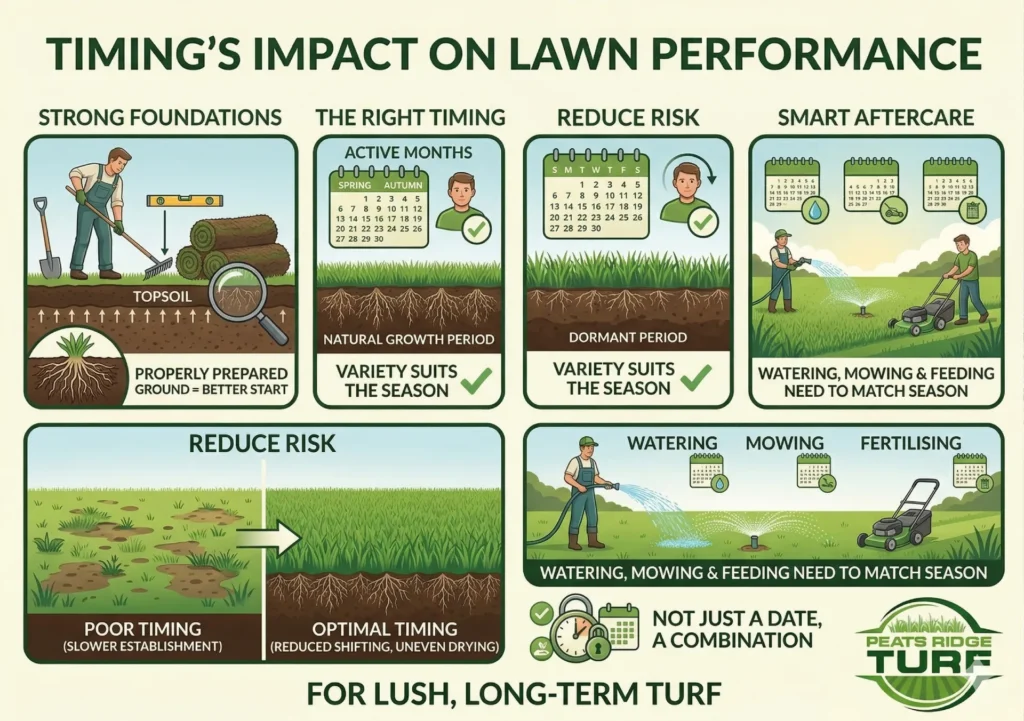
A lawn laid during suitable growing conditions usually develops stronger roots sooner. That helps it stabilise faster, access water more effectively and tolerate use earlier. Strong early establishment also reduces the chance of the lawn shifting, drying unevenly or developing weak patches.
Poor timing, on the other hand, can lead to slower establishment and a longer dependency on careful aftercare. The lawn may still succeed, but it often takes more patience and management to reach the same point.
Long-term performance usually improves when these three things line up:
- The variety suits the season
Turf establishes more smoothly when installed during its natural active growth period. - The ground is properly prepared
Good soil contact and even levels give the turf a better start. - Aftercare is realistic
Watering, mowing and general attention need to match the season and the site.
That is why the best time to install turf is never just a date. It is a combination of readiness, conditions and sensible planning.
Should landscape design influence when turf is installed?
Absolutely. Turf should be timed around the whole landscape build, not treated as the final box to tick once everything else becomes inconvenient.
Hardscaping, edging, irrigation and soil shaping should generally be sorted before turf is laid. Installing turf too early can lead to unnecessary damage from foot traffic, equipment or late changes to the layout. Installing too late can push the project into a less favourable season and make establishment harder than it needs to be.
A well-planned landscape design usually benefits from this sequence:
- Finalise the layout
Decide where lawn, garden beds, paving and borders will sit. - Complete structural work first
Finish retaining walls, paths, irrigation and edging before the turf arrives. - Prepare the soil properly
Make sure the ground is level, clean and ready for immediate laying. - Install turf when conditions support growth
Choose a timing window that gives the lawn the best chance to establish quickly.
This is where experienced local advice can be genuinely useful. People often want general rules, but local conditions, site access and turf variety all affect the right decision. It can help to learn more about the family behind the business when choosing who to buy from, because practical knowledge tends to matter most when a project has moving parts.
So, when is the best time to install turf?
For many Australian landscapes, the best time to install turf is during spring or early summer, when warm-season varieties can establish actively and root into prepared soil more quickly. Autumn can also work well in the right conditions, especially where temperatures remain mild.
The real answer, though, is slightly more useful than naming a season. The best time to install turf is when the ground is ready, the variety suits the site, the weather supports establishment and the aftercare can be done properly. Timing is not about perfection. It is about giving the lawn the strongest possible start.
For a new landscape design, that usually means resisting the urge to rush. Good turf rewards preparation, sensible scheduling and a realistic understanding of how grass actually grows.
Ready to plan the timing properly?
If you are working out When Is the Best Time to Install Turf for a new landscape design, the smartest approach is to match the season, the site and the turf variety from the start. That makes the lawn easier to establish and easier to live with afterwards.For tailored advice on locally grown turf, it is worth speaking with the team at Peats Ridge Turf Supplies. Founded and nurtured by Jeff and Patricia Vassallo, this family-owned business has spent more than 20 years supplying quality turf for residential lawns and commercial landscapes, with the kind of personal service that helps people make confident decisions without the usual landscaping guesswork.